
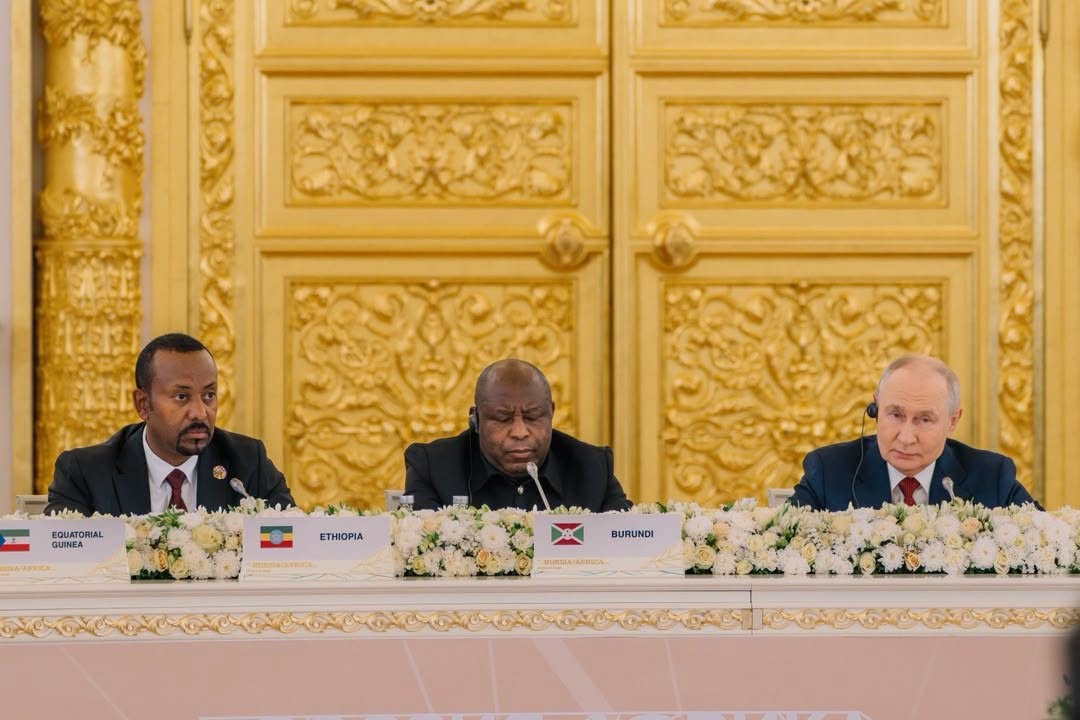
PM Abiy Presents Medemer as a Bridge for Reciprocal Knowledge Exchange Between Ethiopia and Russia
Addis Ababa, October 29, 2026 (FMC) — Ethiopian Prime Minister Abiy Ahmed has highlighted the reciprocal exchange of knowledge between Ethiopia and Russia as a defining feature of their longstanding relationship, drawing a connection between a Russian medical mission that helped Ethiopians after the Battle of Adwa in 1896 and the Russian-language publication of his book *Medemer* this year.
Addressing the plenary session of the Third Russia–Africa Summit in Moscow on Thursday, the Prime Minister framed the two milestones as examples of knowledge moving in both directions, reflecting a partnership built on mutual respect, solidarity and the recognition that each country has something to contribute.
“In 1896, after the Battle of Adwa, a Russian Red Cross mission came to Ethiopia to treat our wounded. The mission also translated a medical guide into Amharic,” Abiy said, describing the translation as “a small act with a large meaning.”
The historical reference placed the relationship between the two countries within a broader context of practical cooperation, in which knowledge serves human needs and creates lasting connections between peoples.
Abiy linked that legacy to the Russian translation of *Medemer*, his homegrown philosophy of synergy and cooperation, which he said had been published this year. He presented the parallel as an illustration of knowledge moving between the two countries rather than flowing in only one direction.
“Our philosophy of Medemer holds that every partner has something to give,” he said. “130 years ago, Russian medical knowledge was translated into Amharic. This year, the book Medemer has been translated into Russian, knowledge moving in both directions.”
The comparison gave the Prime Minister’s address a cultural and intellectual dimension beyond the economic and technological cooperation discussed at the summit. It also reflected his emphasis on partnerships that recognise the contributions of both sides and create opportunities for mutual learning.
In his address, Abiy connected this principle to Ethiopia’s wider pursuit of national capability. He argued that sovereignty gives countries the right to make their own decisions, while the ability to implement those decisions depends on developing knowledge, skills and productive capacity.
He identified food, energy and knowledge as three areas in which Ethiopia is investing, while inviting Russian institutions and enterprises to contribute through agricultural machinery and processing, nuclear science, artificial intelligence, research and industrial partnerships.
His invitation to Russian universities and institutions to collaborate with Ethiopia’s emerging Medemer University of Artificial Intelligence in Addis Ababa further illustrated the practical direction of the partnership. The proposed collaboration would create opportunities for teaching and research while supporting Ethiopia’s efforts to develop its own technological expertise.
The Prime Minister also called for the summit’s action plan to establish clear tasks and timelines, stressing that international cooperation should translate into tangible results.
By connecting the historical experience of the Russian Red Cross mission with the contemporary exchange represented by *Medemer* in Russian, Abiy presented the Ethiopia–Russia relationship as one in which historical ties can provide a foundation for new forms of cooperation.
His message was that a lasting partnership is strengthened not only through diplomatic commitments and economic projects, but also through the exchange of ideas, knowledge and expertise—enabling both countries to contribute to one another’s development.